Software
Web
Listen article:
Choosing the right project management approach is essential for delivering successful projects on time and within budget. Understanding how different methods work can help you make better decisions and avoid common challenges.
Introduction
Choosing the right project management approach can make or break your project. Whether you're building a website, mobile app, or managing a business process, the method you choose affects timelines, costs, and overall success.
You may have heard terms like Agile, Scrum, Kanban, and Waterfall—but understanding how they differ can be confusing, especially for beginners.
In this guide, we will break down each method in simple terms, compare them, and help you decide which one is best for your project.
What is Agile?
Agile is a flexible and modern approach to project management. Instead of planning everything upfront, Agile focuses on continuous improvement, collaboration, and adapting to changes.
Projects are divided into small parts, and teams work on them step by step. Feedback is collected regularly, and improvements are made along the way.
Key Features of Agile:
- Flexible and adaptable
- Continuous feedback and improvement
- Faster delivery in smaller parts
- Strong team collaboration
Agile is widely used in web and app development because requirements often change during the project.
What is Scrum?
Scrum is a framework within Agile. It follows Agile principles but provides a more structured way of working.
In Scrum, work is divided into short cycles called “sprints”, usually lasting 1–4 weeks. At the end of each sprint, a working part of the project is delivered.
Key Features of Scrum:
- Work is done in fixed time periods (sprints)
- Regular meetings (daily standups)
- Clear roles (Product Owner, Scrum Master, Team)
- Frequent delivery of working features
Scrum is ideal for teams that want structure but still need flexibility.
What is Kanban?
Kanban is another Agile-based method, but it is simpler and more visual.
It uses a board (physical or digital) to show tasks in different stages, such as “To Do”, “In Progress”, and “Completed”. This helps teams see the workflow clearly and manage tasks efficiently.
Key Features of Kanban:
- Visual task management
- No fixed time cycles
- Continuous workflow
- Focus on improving efficiency
Kanban works well for ongoing projects or support tasks where priorities change frequently.
What is Waterfall?
Waterfall is a traditional project management method. It follows a step-by-step approach where each phase must be completed before moving to the next.
For example: Planning → Design → Development → Testing → Launch
Once a phase is finished, it is difficult to go back and make changes.
Key Features of Waterfall:
- Fixed structure and clear stages
- Detailed planning upfront
- Less flexibility
- Easier to manage for simple projects
Waterfall is best suited for projects with clear and fixed requirements.
Agile vs Scrum vs Kanban vs Waterfall
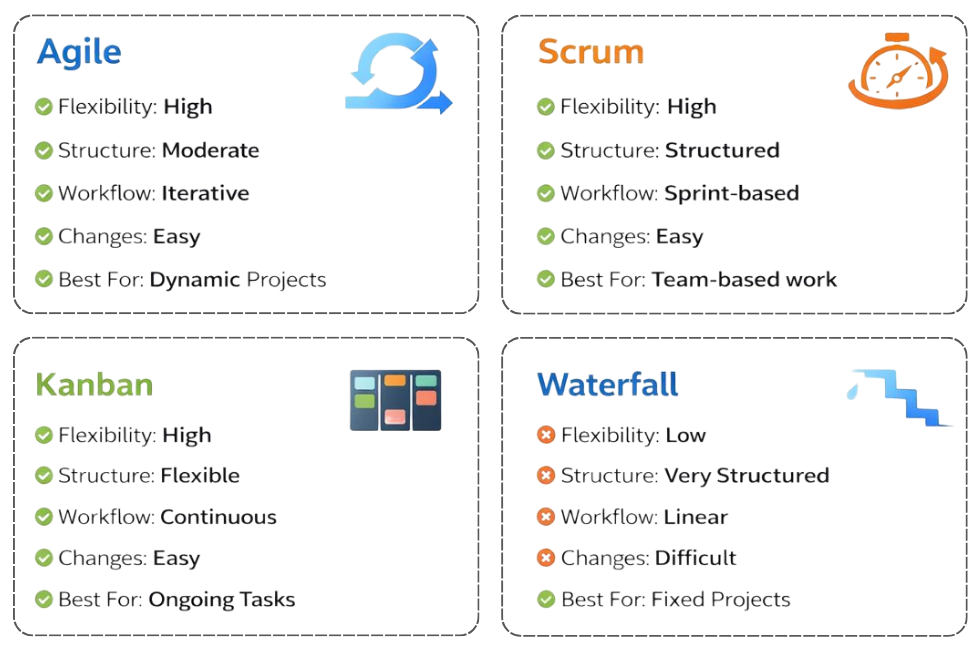
Here's a simple comparison to understand the differences:
When to Use Each Method
Use Agile when:
- Requirements may change
- You need continuous improvements
- You want faster feedback
Use Scrum when:
- You have a dedicated team
- You want structured Agile implementation
- You are building complex products
Use Kanban when:
- You manage ongoing tasks or support work
- You want visual workflow management
- You need flexibility without strict timelines
Use Waterfall when:
- Requirements are clear from the start
- Changes are unlikely
- You need a simple, predictable process
Which One is Best for Your Project?
There is no one-size-fits-all answer. The best method depends on your project goals, team, and flexibility needs.
- For most modern web and app projects → Agile or Scrum is recommended
- For continuous workflows → Kanban works best
- For simple and fixed-scope projects → Waterfall is suitable
Many businesses today even combine methods (called hybrid approach) to get the best results.
Conclusion
Understanding Agile, Scrum, Kanban, and Waterfall helps you make smarter decisions for your projects. Each method has its own strengths, and choosing the right one can improve efficiency, reduce risks, and deliver better results.
If you're unsure which approach is right for your business, working with an experienced development team can make the process much easier.
Share article: